
TL;DR:
- Coffee shops serve as accessible third places that foster social connections and reduce loneliness.
- Community café models like the Chatty Café Scheme and crisis cafes effectively support mental health.
- Cafés promote innovation and community well-being through informal interactions and consistent presence.
Nearly 25% of UK adults feel lonely often, and in a city as vast as London, that number lands hard. Yet the answer to isolation might be closer than you think, sitting right there on the high street with a hand-painted menu board and the smell of freshly ground beans. Coffee shops are doing something quietly extraordinary: turning everyday moments into genuine human connection. This article explores how cafés act as mental health hubs, what community models are working right now, and how you, whether you love coffee or run a café, can be part of something bigger.
Table of Contents
- Why coffee shops matter as third places
- Community café models: Tackling loneliness and providing support
- Social prescribing and the economic impact of community cafés
- Coffee shops and local innovation: The creative ripple effect
- What most guides miss: Creating authentic connections in coffee spaces
- Connect with London coffee culture and support men's wellbeing
- Frequently asked questions
Key Takeaways
| Point | Details |
|---|---|
| Coffee shops boost connection | Coffee shops serve as welcoming spaces, helping Londoners combat loneliness and find community. |
| Café schemes create real change | Initiatives like Chatty Café and crisis cafés provide practical support, improving mental health outcomes. |
| Social prescribing pays off | Referrals to community cafés deliver measurable wellbeing gains and strong return on investment. |
| Creativity thrives in cafés | High café density encourages innovation, benefiting both individuals and local communities. |
| Low-pressure support works | Peer-led, informal café groups are especially effective for engaging men in mental health conversations. |
Why coffee shops matter as third places
Sociologist Ray Oldenburg coined the term third place to describe spaces that are neither home nor work. These are the spots where you show up without an agenda, where conversation happens naturally, and where belonging builds slowly over time. Coffee shops are perhaps the most accessible third place in modern urban life.
The evidence backs this up. Coffee shops foster social connection, reduce loneliness, and actively support mental health in ways that formal services often cannot reach. There is something about the informal nature of a café, the low stakes, the warm drink in hand, that lowers people's defences.
For men in particular, this matters enormously. Clinical settings carry stigma. Structured group therapy can feel intimidating. But pulling up a chair in a familiar café? That feels manageable. Routine visits and casual chat with a barista or a regular customer can quietly improve mood and reduce the sense of isolation that so many men carry silently.
Interestingly, third place research also shows that ambient background noise, the gentle hum of a busy café, can actually boost creative thinking. So these spaces are not just good for the soul. They are good for the mind in multiple dimensions.
Here is what makes coffee shops particularly powerful as community anchors:
- Accessibility: No membership, no appointment, no commitment required
- Regularity: Routine visits build familiarity and trust over time
- Low pressure: Conversation is optional, never forced
- Neutral ground: No hierarchy, no professional roles, just people
- Sensory comfort: Warmth, smell, and sound create a psychologically safe environment
"The café is one of the few places left where you can sit for an hour, spend very little, and feel like you belong somewhere."
If you run a venue and want to understand more about engaging café customers around mental health, or you simply want to understand the link between coffee culture and wellbeing, the case for the café as community space has never been stronger.
Community café models: Tackling loneliness and providing support
Understanding the theory is one thing. Seeing it in practice is another. Across London and the wider UK, café-based community models are already making a measurable difference to people's mental health and sense of belonging.
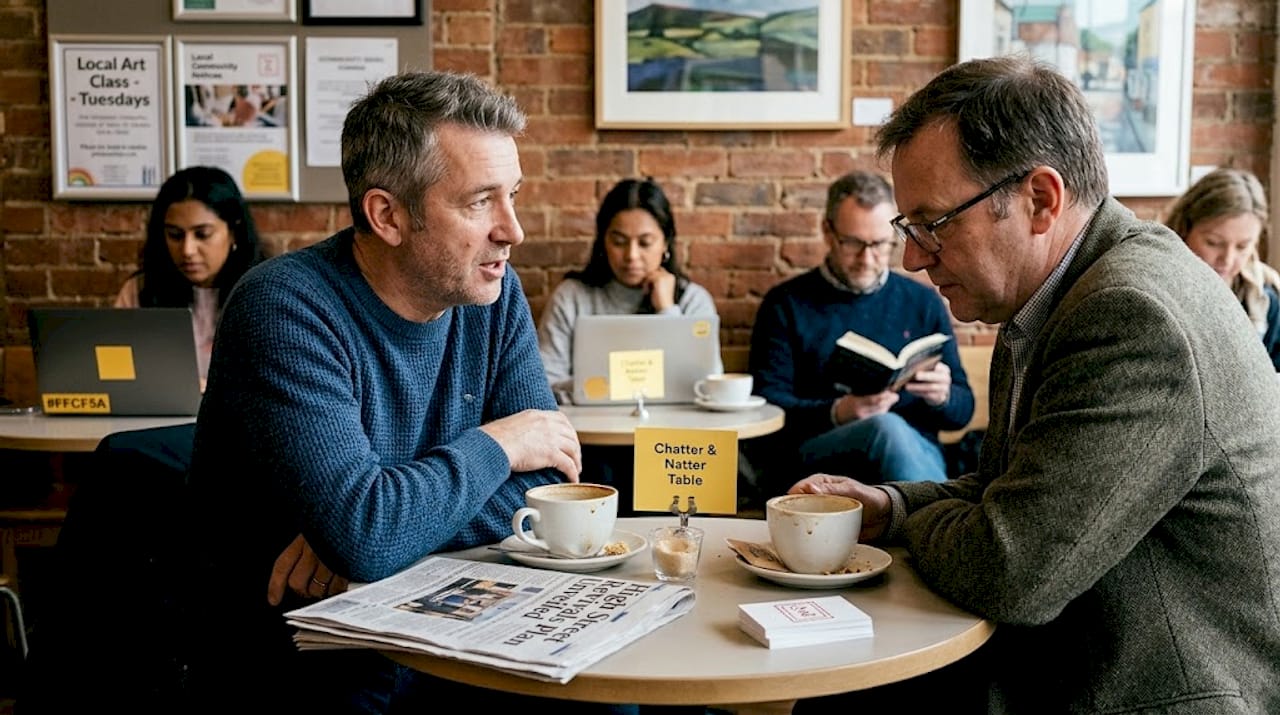
The Chatty Café Scheme is one of the most scalable examples. It designates specific tables inside cafés as Chatter & Natter spots, open to anyone who wants company. No agenda, no facilitator, just an invitation to sit and talk. The scheme now operates in 700+ venues across the UK, and its growth reflects a genuine public appetite for low-barrier social connection.
Then there are crisis cafés and peer-supported community cafés, which operate outside standard NHS hours and provide a safe space for people in distress. These are staffed by trained peers and sometimes clinicians, offering support without the clinical formality of an A&E waiting room. Peer-supported crisis café models have been shown to reduce emergency department visits and build trust among people who would otherwise fall through the gaps.
| Model | Setting | Who it helps | Key feature |
|---|---|---|---|
| Chatty Café Scheme | High street cafés | Anyone feeling isolated | Designated conversation tables |
| Crisis café | Community spaces | People in mental health crisis | Out-of-hours peer support |
| Men's coffee morning | Independent cafés | Men with low social connection | Informal, peer-led format |
| Social prescribing café | GP-linked venues | Referred patients | Structured but relaxed engagement |
Independent cafés consistently outperform chains when it comes to community feel. They know their regulars by name. They notice when someone hasn't been in for a while. That kind of attentiveness is not something a franchise training manual can manufacture.
For café owners looking at community engagement ideas, the practical steps are simpler than you might expect: clear signage, a designated table, a small volunteer network, and consistent scheduled hours. You do not need a large budget. You need intention.
Pro Tip: If you want to launch a community table in your café, start with one morning per week and partner with a local mental health charity to provide light guidance. Consistency matters more than frequency.
London's independent café scene is particularly well placed to explore UK café wellness support, with a growing number of venues already embedding mental health awareness into their day-to-day culture.
Social prescribing and the economic impact of community cafés
Social prescribing is a healthcare approach where GPs and link workers refer patients to non-clinical community activities rather than, or alongside, medication. Think cooking classes, walking groups, and yes, community café sessions. It treats loneliness and low mood as social problems that need social solutions.
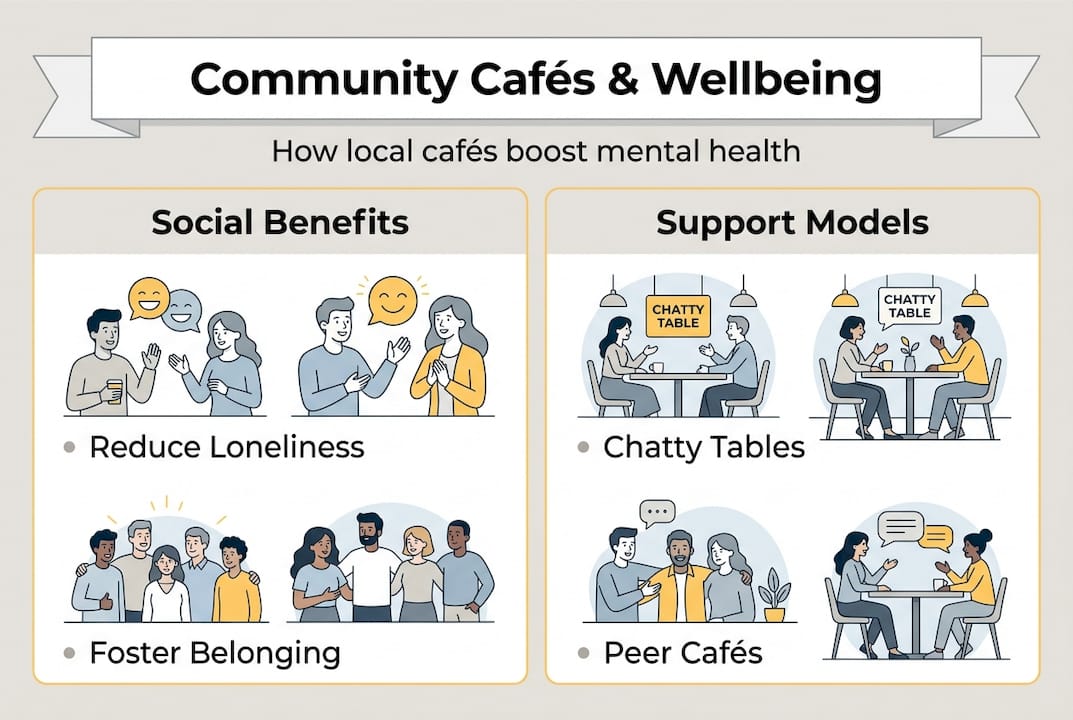
The numbers are compelling. Social prescribing referrals to community activities, including café-based programmes, improve wellbeing by an average of 3.31 points on the SWEMWBS scale (a validated measure of mental wellbeing) and return £9 for every £1 invested. That is not a marginal gain. That is a transformational return.
For café owners, this reframes the question entirely. Running a community morning is not a cost. It is an investment with a measurable social and economic return.
Here is what the data looks like in practical terms:
| Metric | Outcome |
|---|---|
| Wellbeing improvement | +3.31 SWEMWBS points on average |
| Return on investment | £9 per £1 spent |
| Life satisfaction gain | Equivalent to £4,252 in monetary value |
| Reduction in GP visits | Significant in sustained programmes |
For café owners wanting to understand how cafés support men's mental health, or for baristas curious about their role in this space, the evidence suggests that even small, consistent actions carry real weight. A barista's role in mental health is more significant than most people realise.
Practical strategies for café owners to maximise community impact:
- Register with the Chatty Café Scheme or a local social prescribing network
- Display mental health signage and helpline numbers discreetly
- Host a monthly free coffee morning for regulars who come alone
- Partner with a GP surgery or community link worker
- Train staff in basic mental health awareness
Coffee shops and local innovation: The creative ripple effect
The benefits of a thriving café culture extend well beyond individual wellbeing. Research into London's urban geography reveals something fascinating: the density of coffee shops in a neighbourhood is positively linked to local innovation and creativity.
A study examining café density and innovation across more than 30,000 areas found that third spaces like coffee shops correlate with higher rates of patent production and entrepreneurial activity through what researchers call spatial spillovers. Ideas travel through informal conversation. Connections made over a flat white become collaborations.
This is how it tends to unfold:
- A regular customer mentions a problem they are trying to solve
- A stranger at the next table offers an unexpected perspective
- A barista introduces two regulars who share a common interest
- A weekly meetup forms organically around a shared goal
- Something new gets built, a business, a project, a friendship
The café does not force any of this. It simply creates the conditions for it.
"Innovation rarely happens in isolation. It happens in the spaces between formal meetings, in the conversations nobody planned."
For London specifically, this matters because the city's strength has always been its diversity of thought and its density of people. Coffee shops are the connective tissue between communities, industries, and ideas. London cafés supporting charities are already tapping into this energy, using their community pull to raise awareness and funds for mental health causes.
The creative ripple effect is real. When a café becomes a genuine community hub, it does not just improve the mood of its regulars. It raises the creative and social capital of the entire neighbourhood.
What most guides miss: Creating authentic connections in coffee spaces
Most articles about cafés and community focus on events, productivity hacks, or Instagram aesthetics. They miss the point entirely.
What actually moves the needle for men's mental health is not a themed quiz night or a branded loyalty card. It is the slow, unremarkable Tuesday morning when a bloke sits down next to someone he vaguely recognises and they end up talking for forty minutes about nothing in particular. That is where the healing happens.
Independent cafés understand this intuitively. They are not optimising for throughput. They are creating space. The most effective community café we have seen is not the one with the slickest event calendar. It is the one where the staff remember your name, where the regulars look out for each other, and where nobody feels like they need a reason to stay.
For men who are reluctant to seek formal support, this low-pressure environment is not a consolation prize. It is often the first genuine step. A mental health checklist for men can help identify what kind of support feels accessible, but the café itself is often the most honest starting point.
Stop chasing programmes. Start building presence. Show up consistently, make space, and let connection do what it does naturally.
Connect with London coffee culture and support men's wellbeing
At Cup for Bro, we believe every bag of coffee sold is a chance to fund something that matters. We partner with leading UK mental health foundations to ensure that when you buy our beans, you are directly supporting the services and programmes that keep men connected, supported, and well.
Whether you are a café owner looking to make your space a genuine community hub, or someone who simply wants their morning coffee to count for more, we have got something for you. Shop our coffee and put your daily ritual to work. Explore our vision to understand why giving is built into everything we do. Or simply visit Cup for Bro to find out how you can get involved in community action today.
Frequently asked questions
How do coffee shops help reduce loneliness?
Coffee shops act as third places for connection, encouraging routine conversation and social bonding, which lowers the risk of feeling isolated over time.
What is the Chatty Café Scheme and how does it work?
The Chatty Café Scheme places designated Chatter & Natter tables in cafés across the UK, and with 700+ participating venues, it gives anyone the open invitation to sit down and start a conversation.
What is social prescribing in mental health cafés?
Social prescribing involves healthcare professionals referring people to café-based community activities, with measurable wellbeing gains and significantly better life satisfaction outcomes reported across multiple studies.
Why are informal, peer-led café groups effective for men?
Because peer-led café settings remove the clinical formality that puts many men off seeking help, making it far easier to open up and access support without the weight of stigma.