
TL;DR:
- Effective community engagement focuses on measurable impact, inclusivity, partnerships, and sustainability.
- Regular, structured mental health sessions and strong local partnerships build trust and community support.
- Small, consistent initiatives often create deeper, lasting connections than large, one-off campaigns.
Choosing the right community engagement strategy is one of the most underestimated challenges a café owner faces. You want genuine impact, not just a noticeboard flyer or a one-off charity tin. Across the UK, a growing number of cafés are discovering that mental health initiatives, when done thoughtfully, create something far more powerful than goodwill. They build loyal communities, attract partnerships, and deliver measurable outcomes. This article walks you through proven models, practical frameworks, and creative campaigns so you can find the right approach for your café, your team, and your local community.
Table of Contents
- Set criteria for community engagement success
- Run mental health café sessions and peer support events
- Partner with local charities and training providers
- Creative fundraising and conversation starter campaigns
- Comparing engagement models: What works best for your café?
- Our perspective: Why small steps create lasting connections
- Take your café's community engagement to the next level
- Frequently asked questions
Key Takeaways
| Point | Details |
|---|---|
| Start with clear goals | Define what meaningful community engagement means for your café and measure results from the outset. |
| Prioritise partnerships | Partnering with local charities and trainers broadens impact and sustainability for mental health initiatives. |
| Use proven UK models | Adopt and adapt ideas from successful cafés, like neighbourhood mental health sessions and charity collaborations, for your own community. |
| Engage through creativity | Innovative events and campaigns, such as product-linked donations and conversation starters, spark local involvement. |
| Small actions build trust | Regular, co-produced micro-initiatives often outlast one-off events and deepen local mental health support. |
Set criteria for community engagement success
Before you launch anything, it helps to know what success actually looks like. Too many cafés jump straight into hosting events or hanging posters without defining what they are trying to achieve. A clear set of criteria keeps your efforts focused and makes it far easier to measure whether your initiative is working.
The strongest community engagement programmes share four core qualities:
- Measurable impact: You can track attendance, referrals, or feedback, even informally.
- Inclusivity: Sessions and campaigns are accessible to people of different backgrounds, ages, and abilities.
- Partnership: The initiative involves at least one external organisation, charity, or local expert.
- Sustainability: The project can run consistently without burning out your team or your budget.
Mental health as a focus brings an added layer of benefit. When your café becomes a genuinely safe space, you attract regulars who value the environment you have created. The Metronome Be Well Café in Morden demonstrates how cafés can prevent crisis escalation with safe, peer-supported spaces. That is not a small thing. It means your café becomes part of a local safety net, not just a place to buy a flat white.
When it comes to engaging your customers around mental health, the most effective starting point is almost always the simplest one. Talk to your regulars. Ask what they feel is missing in the local area. Co-producing ideas with the people who already trust you produces far better results than importing a programme that worked somewhere else.
Pro Tip: Start with one small, co-produced change suggested by a regular customer. A monthly drop-in, a conversation starter card on each table, or a noticeboard for local support groups costs very little but signals clearly that your café is a place that cares.
Run mental health café sessions and peer support events
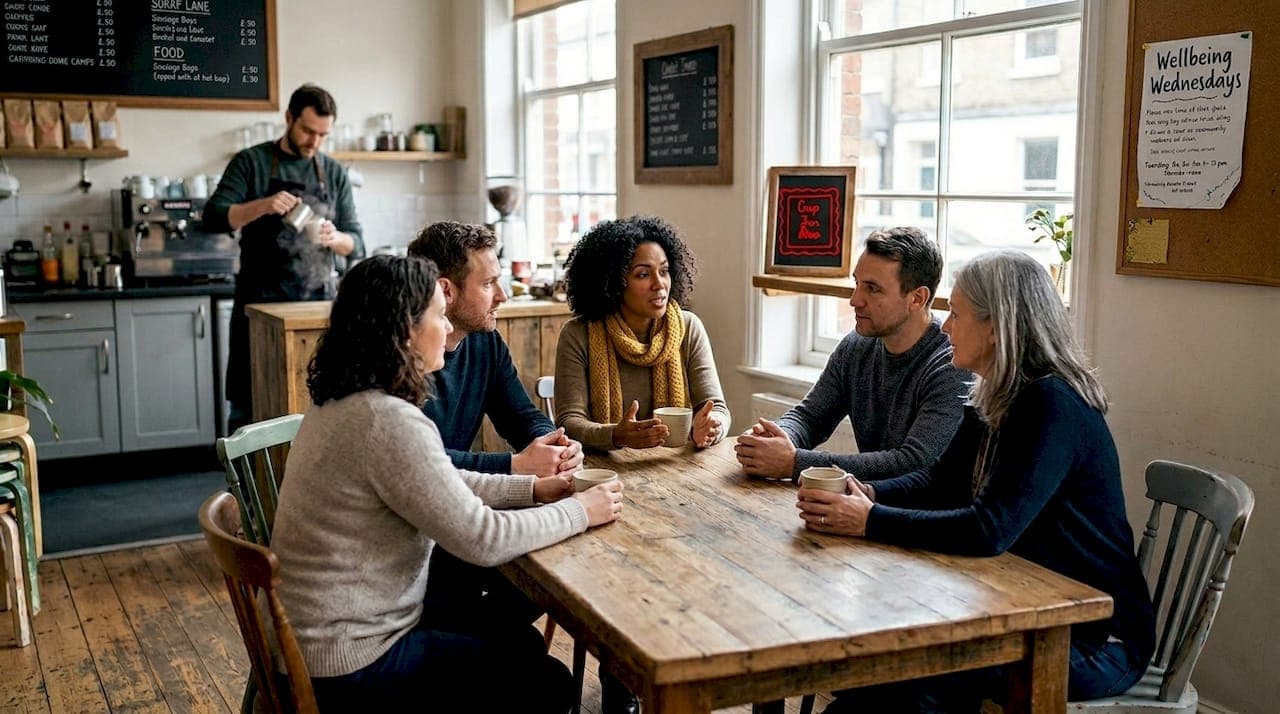
Once you have clear criteria, you can look at proven community mental health models and adapt them to your setting. Hosting regular sessions does not require clinical expertise. What it does require is structure, consistency, and a genuine commitment to creating a welcoming atmosphere.
Here is a practical blueprint for setting up your first sessions:
- Choose a regular time slot, ideally weekly or fortnightly, so attendees can plan around it.
- Partner with a local mental health organisation or trained peer support volunteer to co-facilitate.
- Set clear ground rules at the start of every session: confidentiality, respect, and no pressure to share.
- Have a named contact for crisis situations and ensure all staff know the local emergency referral pathway.
- Collect simple feedback after each session, even just a thumbs up or down card, to track what is working.
The evidence for this model is compelling. Neighbourhood Mental Health Cafés in Leicestershire support 800 people monthly across 40 sessions, showing just how much demand exists at the community level. Meanwhile, the Stevenage Nightlight Crisis Café supported nearly 2,000 individuals, with 93% being self-referrals. That statistic matters because it tells you people are actively seeking out these spaces. They are not being pushed there by a GP. They are choosing to come.
"The café environment removes the clinical barrier. People feel like they are just popping in for a coffee, but they are actually accessing support they might never have sought otherwise."
For staffing, consider a mix of paid staff and trained volunteers. Many mental health charities offer free peer support training. Connecting with supporting community mental wellness resources can help you identify local training opportunities and avoid common pitfalls when managing group dynamics.
Partner with local charities and training providers
Cafés do not have to build community programmes from scratch. Strategic partnerships with charities, NHS trusts, and training providers can multiply your impact enormously, often at very little cost to you.
The benefits of partnering are practical as well as reputational:
- Shared expertise: Charities bring safeguarding knowledge, trained facilitators, and referral networks.
- Increased reach: Their existing service users become aware of your café as a safe, welcoming space.
- Funding access: Some partnerships open doors to grant funding you could not apply for independently.
- Credibility: Association with established organisations builds trust with customers and local media.
The Safe Space Cafe is a strong example. It partnered with Old Spike Roastery for barista training and the Felix Project for surplus food redistribution, creating a model that addresses both mental health and food poverty simultaneously. Similarly, Bright Bean Cafe at St Ann's Hospital reduces isolation and supports employment through barista training for service users, showing how vocational programmes can sit naturally inside a café setting.
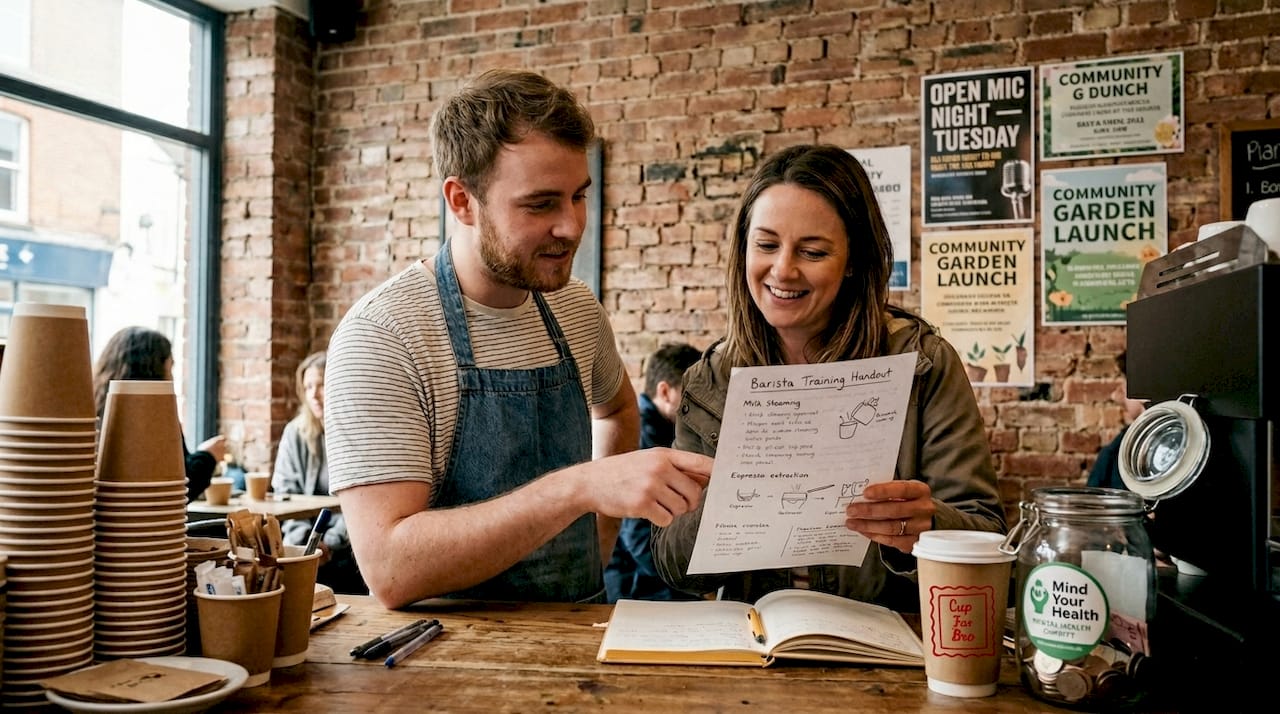
The concept of barista training for wellbeing is particularly powerful because it gives participants a tangible skill alongside the social benefit of being in a supportive environment.
To find the right partners, start with your local council's voluntary sector directory, search the national charity register, or simply reach out to cafés in nearby towns who are already running similar programmes. A short, honest email explaining what you want to achieve goes a long way.
Pro Tip: Rotate your partnership projects with a seasonal or event-based focus. A winter wellbeing series, a Men's Health Week collaboration, or a local arts festival tie-in keeps things fresh for your team and gives you a natural hook for local press coverage.
Creative fundraising and conversation starter campaigns
With foundational projects in place, cafés can amplify their impact through creative campaigns that spark conversations and raise funds simultaneously. The most effective campaigns tend to be product-driven or event-driven, and they work because they give customers an easy way to participate without feeling pressured.
| Campaign type | How it works | Example |
|---|---|---|
| Product-linked donation | A percentage of each sale goes to a named charity | Bloom Coffee donates per sale |
| Event-based awareness | Timed to a local event or awareness week | Coffee for Molly at Brighton Marathon |
| Conversation starter cards | Printed prompts on tables or with orders | Seasonal mental health questions |
| Community noticeboard | Curated local support resources on display | Signposting to local charities |
The Coffee for Molly campaign is a brilliant case study. 13 cafés distributed materials to spark mental health conversations during the Brighton Marathon weekend, turning a high-footfall local event into a platform for awareness. It required minimal budget but created significant community visibility.
Bloom Coffee takes a different approach by donating per sale to the Jac Lewis Foundation's suicide prevention work. The beauty of this model is its simplicity. Every cup sold becomes a contribution, and customers feel good about their purchase without any additional effort on their part.
For practical conversation starter ideas, consider:
- Printed question cards tucked into takeaway cups
- A chalkboard prompt changed weekly with a mental health theme
- QR codes linking to local support resources on your packaging
- A "pay it forward" board where customers can leave a coffee for someone who needs it
For more ideas on fundraising for mental health or practical guidance on driving café donations, there are resources specifically built for UK café owners navigating this space.
Comparing engagement models: What works best for your café?
To bring it all together, it helps to compare what different engagement approaches look like side by side. Each model has distinct strengths, and the right choice depends on your café's size, team capacity, and community context.
| Model | Best for | Resource level | Key outcome |
|---|---|---|---|
| Regular peer support sessions | High-footfall urban cafés | Medium | Social connection, crisis prevention |
| Charity partnerships | Cafés near hospitals or services | Low to medium | Credibility, reach, funding access |
| Barista training programmes | Cafés with space and staff capacity | Medium to high | Employment, skill-building, inclusion |
| Product-linked campaigns | All café types | Low | Awareness, fundraising, customer loyalty |
| Conversation starter campaigns | All café types | Very low | Normalising mental health dialogue |
The evidence for measurable health outcomes is strongest in the crisis café model. The Safe Haven Café in Aldershot reduced psychiatric admissions by 33%, which is a remarkable result for a community-led initiative.
To choose the right approach, work through these three questions:
- What does your local community most need right now? Speak to your customers and local charities to find out.
- What can your team realistically sustain over six to twelve months without burning out?
- Which model aligns with your café's existing identity and values?
Exploring coffee with a cause models can also help you see how other UK cafés have navigated this decision and what they would do differently with hindsight.
Our perspective: Why small steps create lasting connections
There is a temptation in community engagement to think bigger is better. A large awareness event, a high-profile charity partnership, a splashy campaign. These things have their place, but at Cup for Bro we have seen time and again that the most enduring impact comes from something far less glamorous: consistency.
A weekly drop-in that runs for two years builds more trust than a one-off event that attracts 200 people and then disappears. A conversation starter card that sits on every table for six months reaches more people than a single social media campaign. The cafés making the deepest difference are the ones that have made mental health part of their everyday culture, not just a seasonal campaign.
The uncomfortable truth is that large campaigns without local roots often create more noise than change. Co-created, customer-led micro-projects, the kind that emerge from genuine listening, tend to outlast them every time. That is our vision for community impact: not scale for its own sake, but genuine, sustained connection between people who need support and the spaces that can provide it.
Take your café's community engagement to the next level
Ready to make a lasting difference? The ideas in this article are a starting point, not a ceiling. At Cup for Bro, we work directly with UK cafés to help them build meaningful mental health engagement into their everyday offer.
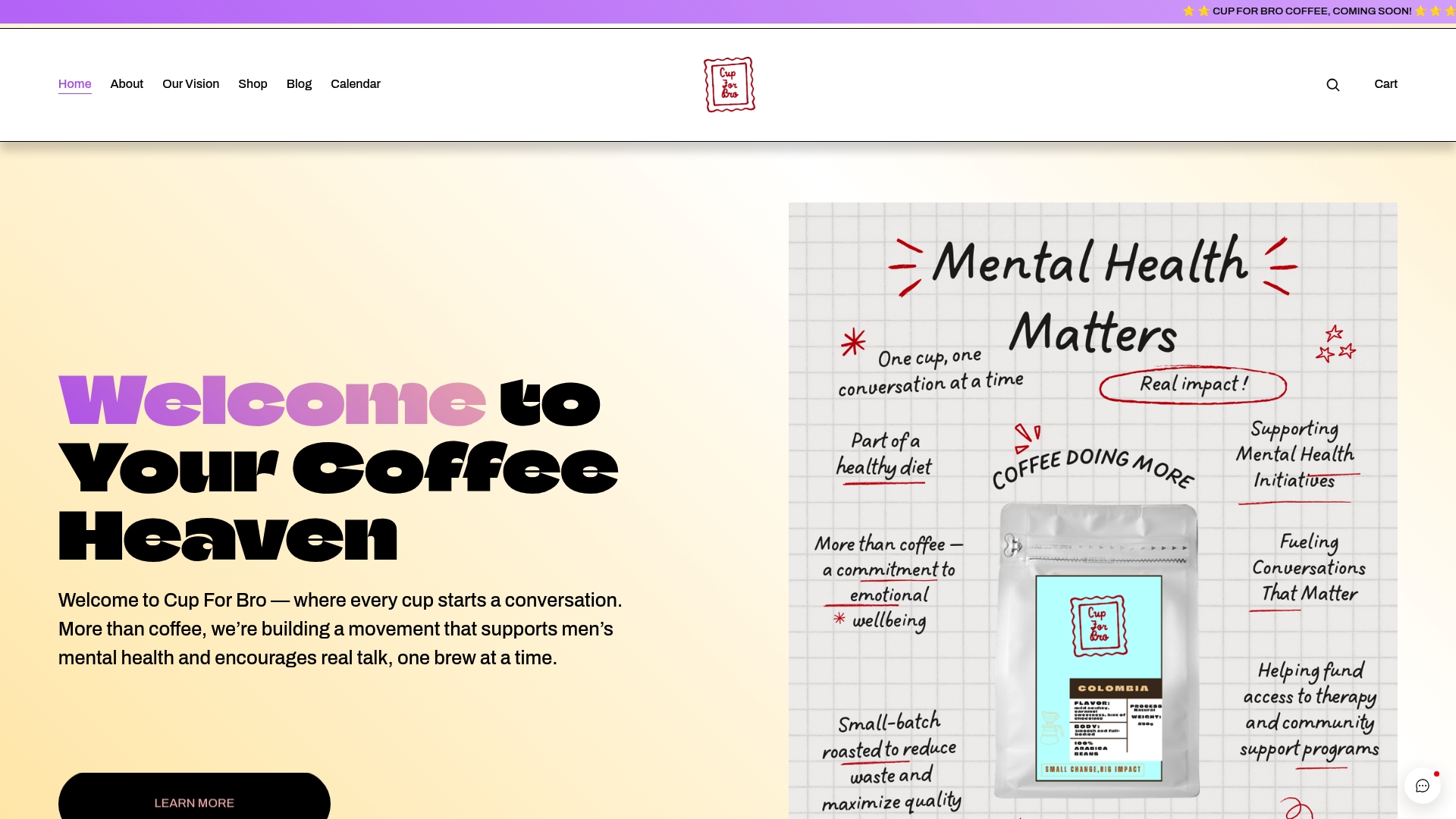
When you browse coffee that supports mental health through Cup for Bro, every purchase funds vital support programmes and services run by some of the UK's leading mental health foundations. You get exceptional coffee, your customers get a reason to feel good about their cup, and the wider community benefits from funded services. You can also explore our mental health initiatives to find conversation starter materials, partnership ideas, and practical resources built specifically for café owners who want to do more than just serve great coffee.
Frequently asked questions
How can I start a mental health café night safely?
Begin with clear safety guidelines, peer support training, and local expert partnerships for supervision. As shown by The Metronome Be Well Café, safe peer-led support and de-escalation planning are essential from day one.
Do charity sales or donations really make a difference?
Yes, direct donations from products or campaigns enable local charities to expand mental health support and resources. Bloom Coffee donates per sale to the Jac Lewis Foundation, directly supporting suicide prevention work in the community.
What's the best way to find reliable local partners?
Connect through local council directories, mental health charities, and other cafés involved in collaborative programmes. Safe Space Cafe built its model by partnering with local providers for holistic, joined-up support.
Are there proven models for mental health café programmes in the UK?
Yes, Neighbourhood Mental Health Cafés, Safe Haven Café, Bright Bean Café, and others show strong community outcomes. Neighbourhood Mental Health Cafés support 800 people monthly, demonstrating the scale of need and the appetite for these community-based spaces.