

TL;DR:
- Cafés are becoming influential community spaces for supporting men's mental health through authentic partnerships.
- Successful initiatives require team buy-in, clear goals, proper planning, and ongoing communication.
- Consistent, small efforts over time build trust and long-term community impact.
Cafés have quietly become some of the most powerful community spaces in the UK, and more owners are asking how they can use that position to genuinely support men's mental health. The demand is real. Customers are increasingly loyal to businesses that stand for something, and mental health has never been more central to public conversation. A poorly planned partnership, however, can lose momentum fast, frustrate your team, and deliver little real impact. This guide walks you through everything you need to know: what to prepare, how to launch, what mistakes to sidestep, and how to keep the good work going long after your first campaign.
Table of Contents
- What you need before starting a café partnership
- Step-by-step process to form a café partnership
- Common pitfalls and how to avoid them
- Measuring impact and sustaining your partnership
- A fresh perspective on café partnerships for mental health
- Partner with Cup For Bro to make a difference
- Frequently asked questions
Key Takeaways
| Point | Details |
|---|---|
| Prepare before you start | Get your team, resources, and expectations set before launching a partnership. |
| Follow step-by-step instructions | Use a clear process to setup, launch, and promote your mental health initiative. |
| Avoid common mistakes | Stay clear of pitfalls like unclear roles or poor communication with regular feedback. |
| Measure and adjust | Consistently track results and celebrate successes to keep your partnership thriving. |
What you need before starting a café partnership
Before anything else, honesty matters. A café partnership built on genuine commitment will always outlast one launched on impulse. The first thing to assess is whether your team is truly behind the idea. Staff who understand why this matters will carry the initiative forward naturally, without it feeling like an add-on to their working day.
Understanding initial requirements and community expectations is vital before signing any agreements or making public promises. Customers notice authenticity quickly, and your community will hold you accountable in the best possible way.
Here is a straightforward checklist of what you need in place before launching:
- Team buy-in: At least one member of staff acting as an internal champion
- Suitable menu or product: A coffee range or specific product tied to donations
- Charity partner confirmed: Agreement in principle with a mental health organisation
- Donation system: A simple and transparent way to collect and pass on funds
- Promotional material: In-café signage, social media assets, and talking points
- Basic staff training: Enough knowledge to speak confidently about the cause
The table below shows what each requirement involves and how long it typically takes to put in place:
| Requirement | What it involves | Typical setup time |
|---|---|---|
| Team buy-in | Staff meeting, Q&A, volunteer champion | 1 to 2 days |
| Menu tie-in | Choose a product, set donation amount | 2 to 3 days |
| Charity partner | Research, contact, agreement | 1 to 3 weeks |
| Donation system | Point-of-sale integration or a jar and tracking sheet | 1 week |
| Promotional material | Design and print | 1 to 2 weeks |
| Staff training | Briefing session or short guide | Half a day |
For ideas on how to bring customers into the conversation from the start, exploring community engagement ideas for cafés is well worth your time.
Pro Tip: Run a brief role-play session with your team before launch. Practise how to answer a customer who asks what the partnership is about. Confident, natural answers do far more than any poster on the wall.
Step-by-step process to form a café partnership
Now that the requirements are clear, it is time to move on to the practical process. This does not need to be complicated. The most successful café partnerships start with a clear goal and build from there.
- Identify a mental health partner. Research organisations that align with your values. National charities offer scale and credibility. Local groups offer intimacy and direct community connection. London café partnerships show how partnering with mental health charities can provide valuable support and guidance throughout the process.
- Define your goals. Are you raising funds, building awareness, or hosting events? Specificity matters. "We will donate 50p from every bag of coffee sold in November" is far stronger than "we want to help."
- Set your donation or campaign structure. Decide whether funds come from product sales, tip jars, events, or a combination. Linking charity coffee sales directly to specific products is one of the most transparent and engaging methods available.
- Agree on roles and reporting. Who tracks the donations? Who communicates with the charity? Who updates customers on progress? Write this down.
- Set a launch date and plan a small event or social media moment to mark the beginning publicly.
The table below compares three common partnership formats to help you choose the right fit:
| Partnership type | Best for | Pros | Cons |
|---|---|---|---|
| In-house campaign | Full control | Flexible, branded | Requires more internal effort |
| Local charity tie-in | Community visibility | Personal, trusted | Limited reach |
| National charity partner | Credibility and scale | Established support | Less flexibility |

Common pitfalls and how to avoid them
After the step-by-step guide, it is essential to be aware of potential setbacks and how best to prevent them. Even well-intentioned partnerships can stall or quietly fade out without the right safeguards.
The most common mistakes café owners make include:
- Setting unrealistic targets: Promising to raise £10,000 in a month puts pressure on the team and disappoints customers if it falls short
- Weak promotion: Relying solely on a sign by the till means most customers will never know the partnership exists
- Unclear internal roles: When nobody owns the initiative, everyone assumes someone else is managing it
- Forgetting to celebrate progress: Small wins ignored are opportunities for team motivation wasted
- Not revisiting the partnership: What worked in month one may need adjusting by month three
Poor communication and lack of staff engagement are frequent causes of failed partnerships, which is why setting up clear internal processes from the start is so important. If you want practical advice on driving donations once you are live, that is a good place to look next.
"Regular check-ins with your team and your charity partner are not a luxury. They are the mechanism that keeps the whole thing alive."
Pro Tip: Schedule a 15-minute monthly review between your champion and the charity contact. It sounds small, but this single habit prevents more partnerships from collapsing than any other measure.
Measuring impact and sustaining your partnership
Once pitfalls are understood, it is time to ensure your efforts show real results and remain effective long-term. Measurement does not have to mean spreadsheets and quarterly reports. It just means knowing whether what you are doing is working.
Here are some straightforward ways to track your café's impact:
- Funds raised: Total donations passed to your charity partner per month
- Customer awareness: Ask a few regulars each week if they know about the initiative
- Team engagement: Are staff mentioning it unprompted? Are they proud of it?
- Social reach: Likes, shares, and comments on posts about the partnership
- Event attendance: If you run in-café events, track who shows up and whether numbers grow
The table below outlines a simple quarterly review framework:
| Review area | What to ask | How to measure |
|---|---|---|
| Financial impact | How much was raised this quarter? | Donation totals |
| Community reach | Are more people aware of the cause? | Customer conversations, social stats |
| Staff morale | Does the team feel good about the work? | Informal check-in |
| Partnership health | Is the charity relationship strong? | Monthly call with partner |
Regular evaluation ensures your partnership remains effective and meaningful over time. For longer-term thinking, looking at give back strategies that other cafés have used successfully will give you fresh ideas when momentum dips.
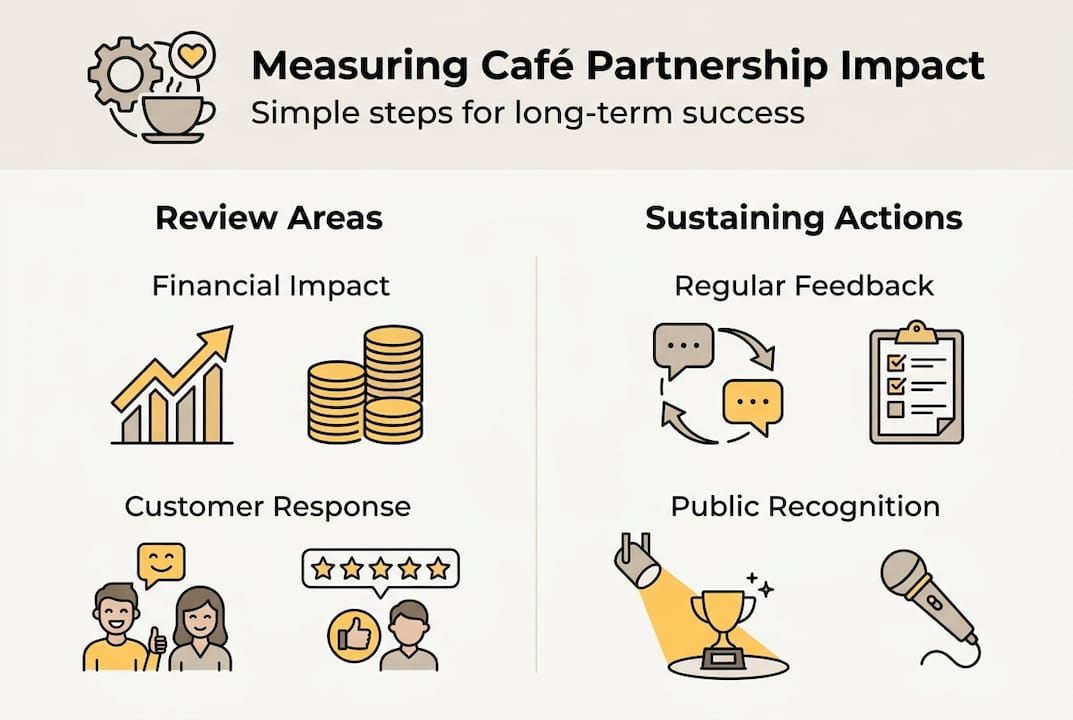
Celebrating publicly matters too. Share your donation totals on social media. Thank your customers by name when you can. Let your community see the numbers adding up.
A fresh perspective on café partnerships for mental health
Here is something most partnership guides will not tell you: the cafés that make the biggest long-term difference are rarely the ones with the most polished campaigns. They are the ones that simply keep going.
The instinct to launch perfectly is understandable. You want customers to be impressed, your charity partner to be confident, and your team to feel proud. But the search for the ideal launch often delays the actual start by months. And in that time, nothing happens.
Local fundraising success stories consistently show that small, consistent actions build trust faster than ambitious one-off campaigns. A café that donates £50 every single month for two years has done something remarkable, even if it never trended online.
The most meaningful community connections are built through repetition and reliability. Customers begin to associate your café with something larger than coffee. Staff feel part of a cause rather than a job. That shift in identity is where the real impact lives. Stop waiting for the right moment. Start with what you have, right now, and improve as you go.
Partner with Cup For Bro to make a difference
If you are inspired to start or expand your own café's role in this movement, here is how Cup For Bro can help.
Cup For Bro works directly with cafés across the UK to make mental health partnerships straightforward, meaningful, and financially transparent. We supply premium coffee beans where every sale funds vital men's mental health programmes through our charity partners. There is no complicated setup and no guesswork about where the money goes. When you shop our coffee partnership range, you are joining a network of businesses that have decided giving is simply part of how they operate. To understand the full story behind what we do and why we do it, learn more about Cup For Bro and see how your café could be the next one making a real difference in your community.
Frequently asked questions
What is the typical starting cost for a café/mental health partnership?
Most partnerships can begin with minimal outlay, often just the cost of promotional materials and a simple donation tracking system. Initial resource requirements are modest for community-focused partnerships, making them accessible for cafés of all sizes.
Which charities are popular partners for UK cafés?
Mental health organisations such as Mind and CALM are frequently chosen by UK café owners, given their strong public recognition and clear focus on accessible mental health support.
How long does it take to launch a coffee donation campaign?
A straightforward campaign can be ready in as little as two to four weeks with the right preparation in place. Quick setup is possible when you follow a structured step-by-step guide from the outset.
How do you keep staff engaged in the partnership?
Involve your team from the very beginning, share regular updates on funds raised, and take time to celebrate what you have achieved together. Staff engagement is crucial for keeping the partnership alive and growing over the long term.