
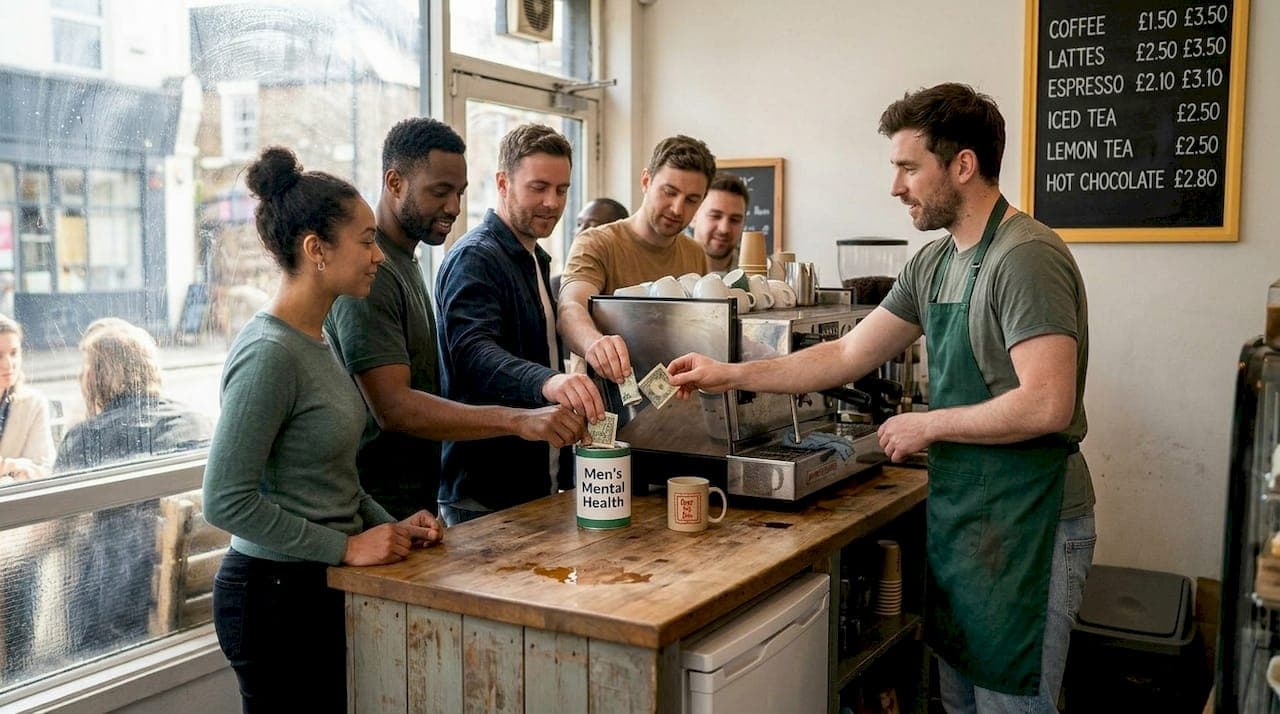
One in eight men in the UK lives with a mental health condition, yet most never seek help. That silence costs lives. What is quietly changing that picture is not a government scheme or a clinical programme. It is a cup of coffee, shared in a familiar local café, surrounded by community. From casual brew and chat sessions that grew into full charities, to ongoing donation models raising tens of thousands of pounds, UK cafés are proving that the most powerful mental health intervention can start with a kettle and a kind word.
Table of Contents
- Why fundraising for men's mental health matters in local cafes
- Popular fundraising models for cafes: Events, donations, and ongoing campaigns
- Keys to successful fundraising: Promotion, partnerships, and customer engagement
- Challenges and solutions: The realities of cafe fundraising
- Real-world impact: Case studies and next steps for UK café managers
- Connect your café to impact: Resources and next steps
- Frequently asked questions
Key Takeaways
| Point | Details |
|---|---|
| Cafes drive community impact | Local cafes are uniquely positioned to support men's mental health via accessible fundraising events and campaigns. |
| Multiple fundraising models work | Event-driven fundraisers, ongoing sales-based donations, and charity partnerships all deliver real results. |
| Promotion and engagement matter most | Strong social promotion, collaboration, and customer incentives are key to successful fundraising efforts. |
| Challenges are manageable | Budget and turnout issues are common but easily overcome by working with local charities and using digital tools. |
| Proven success inspires action | Case studies show even small cafes can raise thousands and spark significant change in their communities. |
Why fundraising for men's mental health matters in local cafes
Men in the UK are statistically far less likely to seek mental health support than women, and suicide remains the leading cause of death for men under 50. These are not abstract numbers. They represent fathers, brothers, colleagues, and friends. The challenge is not just funding, it is access. Men often avoid clinical settings but will walk into a café without a second thought.
That is precisely why cafés hold such unique power. They are neutral, familiar, and low-pressure. There is no appointment, no waiting room, no stigma attached to walking through the door. Baristas support mental health in ways that go far beyond making a good flat white. They create the conditions for honest conversation.
"What started as a casual coffee morning became York Menfulness, a charity now supporting hundreds of men across the region. Andy's Man Club followed a similar path, with brew and chat sessions becoming a national movement."
Local cafés are uniquely positioned to drive this change because they offer:
- A trusted, familiar setting that removes the barrier of formal mental health services
- Regular footfall from the local community, creating natural fundraising opportunities
- Flexible formats that suit both one-off events and ongoing donation models
- Visible commitment to a cause that resonates deeply with customers and staff alike
Having established the broader context, let us examine how cafés actually organise successful fundraising events.
Popular fundraising models for cafes: Events, donations, and ongoing campaigns
There is no single blueprint for café fundraising, and that is actually good news. Whether you run a small independent spot with three tables or a busy high street venue, there is a model that fits.
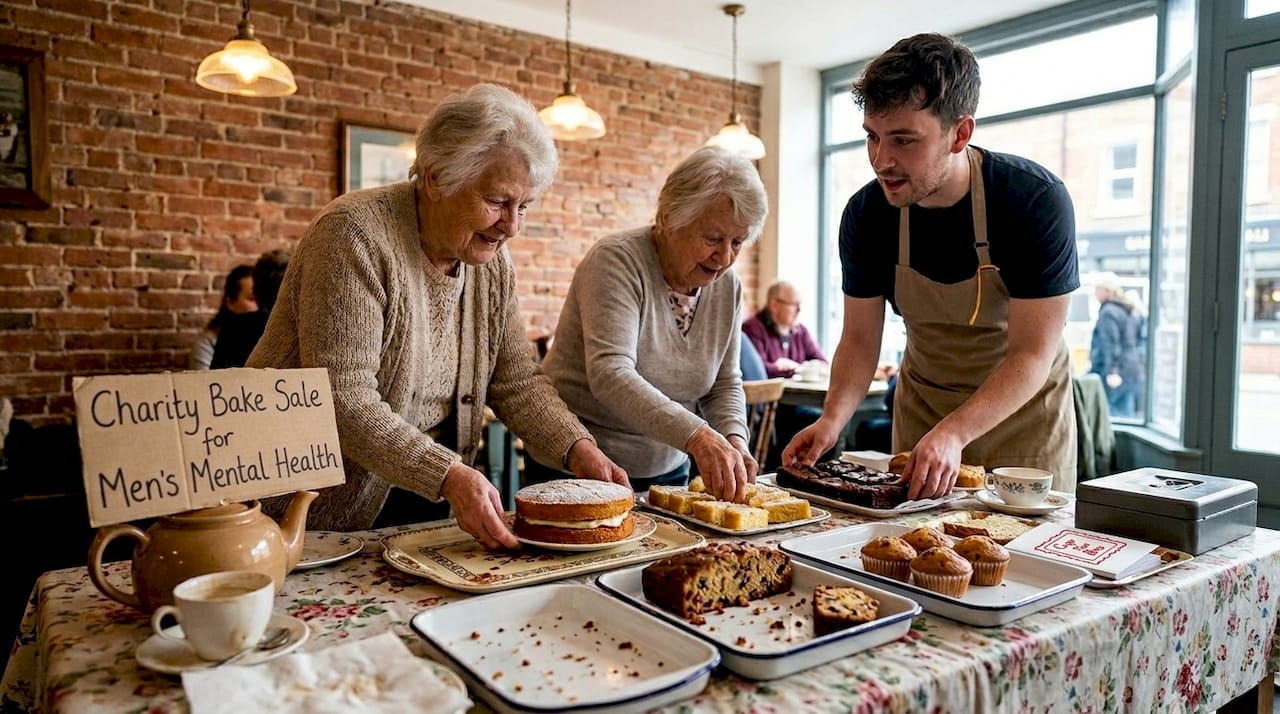
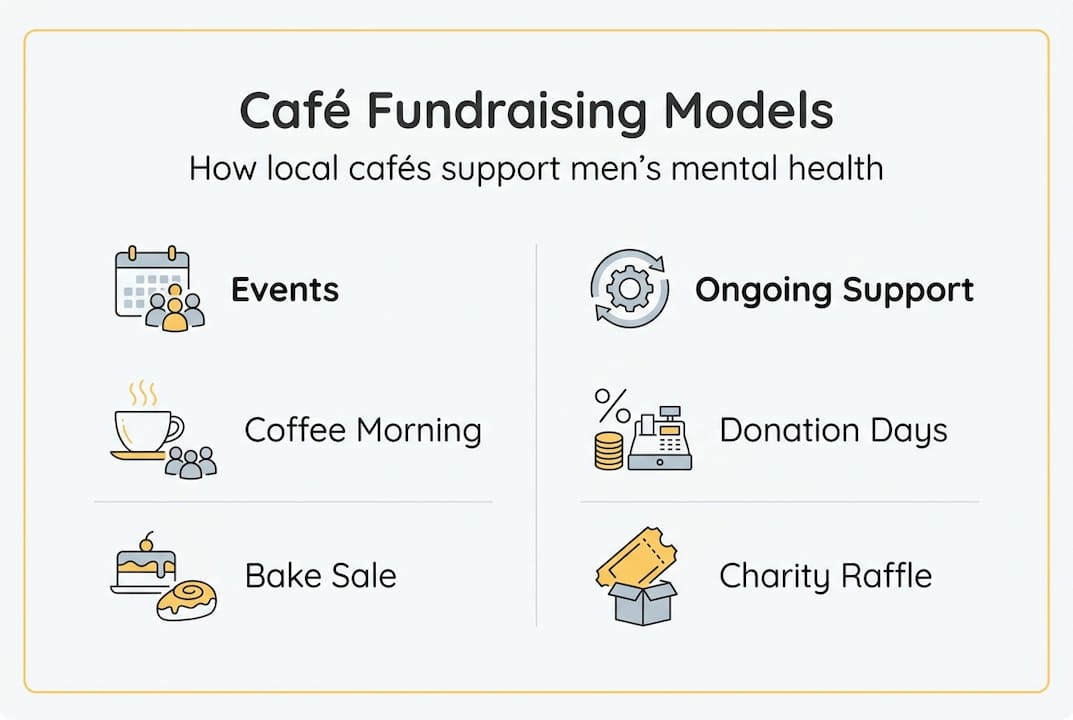
The most common approach is the event-driven model. This includes one-off coffee mornings and bake sales, themed brew and chat sessions, and awareness days tied to campaigns like Movember or World Mental Health Day. These events create energy, attract media attention, and give customers a clear reason to spend more and give more. Some cafés report a 30 to 45% sales uplift during well-promoted fundraising events.
The second model is the ongoing percentage donation. Rather than relying on big event days, a café commits to donating a fixed percentage of every sale, or every sale of a specific product, to a chosen charity. This suits smaller venues with limited staff capacity. It builds a consistent giving habit and keeps the cause visible every single day.
Real-world results prove both approaches work. Bicester Bean Café raised over £22,000 since 2017 through raffles and bake sales. No Limits Café raised £40,000 via a Crowdfunder campaign. These are not flukes. They are the result of consistent effort and smart planning. You can explore charity coffee campaign steps and London charity café models for further inspiration.
| Approach | Setup effort | Ongoing commitment | Typical impact | Key challenge |
|---|---|---|---|---|
| One-off event | High | Low | Large short-term spike | Requires planning and promotion |
| Regular event series | Medium | Medium | Builds community habit | Needs consistent scheduling |
| Percentage of sales | Low | High | Steady, compounding income | Slower to gain visibility |
| Crowdfunding campaign | Medium | Low | Can reach large totals fast | Requires strong online presence |
Now that the core fundraising models are clear, let us look at how to maximise impact and avoid common pitfalls.
Keys to successful fundraising: Promotion, partnerships, and customer engagement
A brilliant fundraising idea with no promotion is just a quiet afternoon. The cafés that raise the most are not necessarily the biggest. They are the most organised and the most connected.
Effective promotion starts well before the event. Use your social media channels to build anticipation, share the story behind the cause, and post countdowns. Email your regulars directly. Loyalty incentives, such as a free coffee for every donation above a certain amount, drive both giving and repeat visits. Themed events and raffles consistently outperform generic fundraising days because they give customers something to talk about and share online.
Partnering with a charity adds credibility and practical support. Many organisations will provide collection boxes, branded bunting, promotional materials, and even staff to attend your event. This reduces your workload and signals to customers that their donation is going somewhere real. Explore customer engagement tips and connect with mission-driven fundraising partners who already have the infrastructure in place.
Here is a straightforward process for launching your first fundraising event:
- Choose your cause and confirm your charity partner
- Set a clear fundraising target and timeline
- Pick your format: event day, ongoing sales donation, or Crowdfunder
- Create your promotional plan across social media, email, and in-store signage
- Brief your team so every staff member can speak confidently about the cause
- Launch your JustGiving or donation page at least two weeks before the event
- Follow up after the event with results, thank-yous, and a teaser for the next one
Pro Tip: Low turnout is the number one fear for café fundraisers. The simplest fix is to co-host with a local mental health group. Their existing audience becomes your audience, and the event carries far more weight in the community.
| Engagement level | Promotion effort | Charity partnership | Typical outcome |
|---|---|---|---|
| High | Multi-channel, early start | Yes, with materials | Strong turnout, media coverage, repeat giving |
| Low | Last-minute social post only | No | Poor attendance, minimal donations |
Having covered best practices for success, it is useful to address the challenges cafés actually face.
Challenges and solutions: The realities of cafe fundraising
Not every fundraising day goes to plan. That is normal, and it does not mean the model is broken. It means you need a realistic picture of what can go wrong and how to handle it.
The most common obstacles café owners report include:
- Limited budget for event materials, promotion, and staffing
- Staff time constraints, particularly in smaller venues with lean teams
- Low public awareness of the cause or the event itself
- Donor fatigue if events are too frequent without fresh angles
- Uncertainty about charity compliance and how to handle donations correctly
The good news is that small cafés succeed consistently by keeping things simple. An ongoing percentage of sales model requires almost no additional resource once it is set up. Collaborating with neighbouring businesses shares the promotional load. Match funding, where a local business or employer agrees to match every pound raised, can double your total without doubling your effort.
"70% of consumers say they prefer to spend with local businesses that are actively involved in their community and support charitable causes."
Pro Tip: Consistency matters more than scale. A café that mentions its mental health mission every single week, through a chalkboard sign, a social post, or a staff conversation, builds far deeper loyalty than one that runs a single big event and goes quiet. Explore sustainable fundraising models and remember that small actions create big impact over time.
With practical ways to overcome challenges in place, let us look at the transformative impact and the next steps for café owners.
Real-world impact: Case studies and next steps for UK café managers
The numbers speak clearly. Bicester Bean Café raised £22,000+ through years of consistent raffles and bake sales. No Limits Café reached £40,000 via Crowdfunder. Combined, these two venues alone have contributed over £62,000 to causes that fund real support services for real people.
These are not large chains with marketing departments. They are independent cafés run by people who decided that their business could do more than serve good coffee. That decision is available to every café owner reading this.
If you are ready to start, here are the practical steps to take right now:
- Choose your cause and research which charities align with your values and your community
- Start small with a single event or a percentage-of-sales commitment on one product
- Tell your story on social media before, during, and after every fundraising activity
- Measure your results and share them publicly to build trust and momentum
- Connect with networks like Cup for Bro that already link cafés to mental health funding
- Plan your next step before the current one ends, so momentum never drops
Read inspiring café stories from venues already making a difference, and use them as your roadmap rather than starting from scratch.
Connect your café to impact: Resources and next steps
Your café already has everything it needs to make a genuine difference to men's mental health in your community. The community, the footfall, the trust, and the coffee are all there.
Cup for Bro works directly with cafés across the UK, supplying ethically sourced coffee fundraisers that fund men's mental health programmes with every bag sold. There is no complicated setup. You stock the coffee, you sell it, and a portion goes directly to vital support services. Start your impact today by browsing our café partnership options, or see our mission to understand exactly where the funding goes and who it helps. This is the simplest way to turn your daily trade into something that saves lives.
Frequently asked questions
How much money can a café typically raise for men's mental health charities?
Most cafés raise anywhere from a few hundred pounds through a single event up to tens of thousands over time. Bicester Bean raised £22,000+ across several years, showing what consistent effort can achieve.
Do fundraising events require charity partnerships or official kits?
Not always. Many cafés run successful coffee mornings and bake sales independently, using simple donation tins and social media to collect and promote giving.
What are the best ways to promote fundraising events at a café?
Social media, email newsletters, and in-store signage are the most effective tools. Themed events and raffles consistently generate higher engagement and sharing than generic donation requests.
How can small cafes maximise fundraising despite limited resources?
The most resource-efficient approach is donating a percentage of sales on a specific product, combined with local partnerships that share the promotional effort without adding cost.