
TL;DR:
- Coffee-based peer support reduces stigma and encourages men to discuss mental health casually.
- Informal coffee gatherings create safe, relaxed environments for genuine human connection.
- The approach builds trust through consistency, familiarity, and non-judgmental conversations.
Mental health support does not always have to start in a therapist's office. Sometimes it begins with a warm mug, a familiar face, and the courage to say, "I've been struggling a bit lately." Cup For Bro is a UK-based initiative using coffee to spark honest conversations about men's mental health, and the results speak for themselves. If you've heard the phrase "Cup For Bro model" and wondered what it actually means, you're not alone. This article breaks down the approach, explains why it works, and shows you exactly how to get involved.
Table of Contents
- Understanding the Cup For Bro model
- How coffee breaks the stigma: Why it works
- Inside a Cup For Bro event: What to expect
- The growing impact: Cup For Bro and the UK movement
- Why conversations over coffee can change the game
- Join the movement: Take your next step
- Frequently asked questions
Key Takeaways
| Point | Details |
|---|---|
| Coffee sparks connection | A simple coffee meet-up can open doors to honest conversations for men's wellbeing. |
| No rigid framework | Cup For Bro thrives on informal, peer-led gatherings, not formal therapy or charity protocols. |
| Community impact grows | The model is part of a larger UK movement using everyday settings to tackle mental health stigma. |
| Easy to get involved | Anyone can participate or support by attending events or trying unique coffee blends. |
Understanding the Cup For Bro model
When people refer to the "Cup For Bro model," they are not pointing to a rigid clinical framework or a formally published methodology. There is no explicit model in the traditional sense. What exists instead is something arguably more powerful: a coffee-as-conversation approach that lowers the barrier for men to talk openly about how they are feeling.
At its core, Cup For Bro operates through a few interconnected activities:
- Unique coffee blends crafted and sold to consumers and businesses, with proceeds funding mental health support programmes
- Community events where men gather informally over a brew to connect and share
- Peer conversations that are unscripted, pressure-free, and centred on genuine human connection
- Partnerships with some of the UK's leading mental health foundations to ensure funding reaches those who need it most
What separates this from a charity tin on a counter or a clinical referral pathway is the intentionality of the setting. Coffee is familiar. It is social. It removes the clinical sterility that puts so many men off seeking support in the first place. You can explore initiative insights to see how this plays out in practice across different communities.
"The most important conversation a man can have about his mental health often starts not with a professional, but with a mate who asks, 'You alright?'"
This is the spirit behind everything Cup For Bro does. It is not replacing therapy or clinical care. It is creating the conditions where men feel safe enough to admit they might need it. For a deeper look at community methods for men's mental health, the evidence for peer-led approaches is growing steadily.
Pro Tip: If you are attending a peer conversation event for the first time, resist the urge to have your "story" prepared. The most meaningful exchanges happen when you simply show up, listen, and let the conversation find its own direction.
The model, if we must call it that, is built on trust, repetition, and the quiet power of showing up consistently for one another.
How coffee breaks the stigma: Why it works
The initiative supports men through unique coffee blends and community events, but the deeper question is why coffee specifically is so effective at dismantling the walls men build around their emotions.
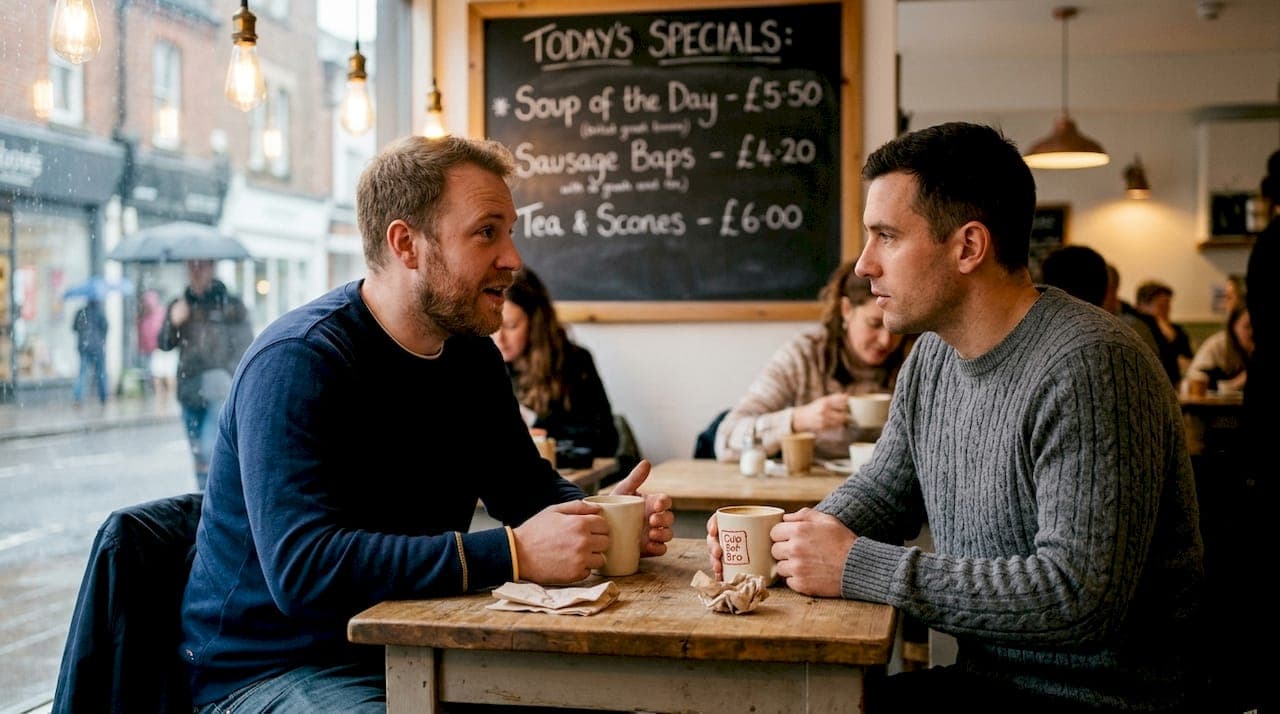
Informal settings fundamentally change how people communicate. When you sit across from someone in a café rather than a clinical waiting room, your nervous system relaxes. There is no clipboard, no intake form, no sense that you are being assessed. You are just two people sharing a drink. That shift in environment translates directly into a shift in openness.
Similar UK initiatives like Brew & Chat community events use the same principle, confirming that coffee catch-ups are becoming a recognised methodology for peer support across the country.
| Feature | Coffee-centred events | Formal mental health services |
|---|---|---|
| Ease of access | Walk in, no referral needed | Referral often required |
| Comfort level | High, familiar social setting | Can feel clinical or intimidating |
| Engagement | Conversational and organic | Structured and appointment-based |
| Accessibility | Community venues, low cost | Waiting lists, potential fees |
| Stigma barrier | Very low | Moderate to high for many men |
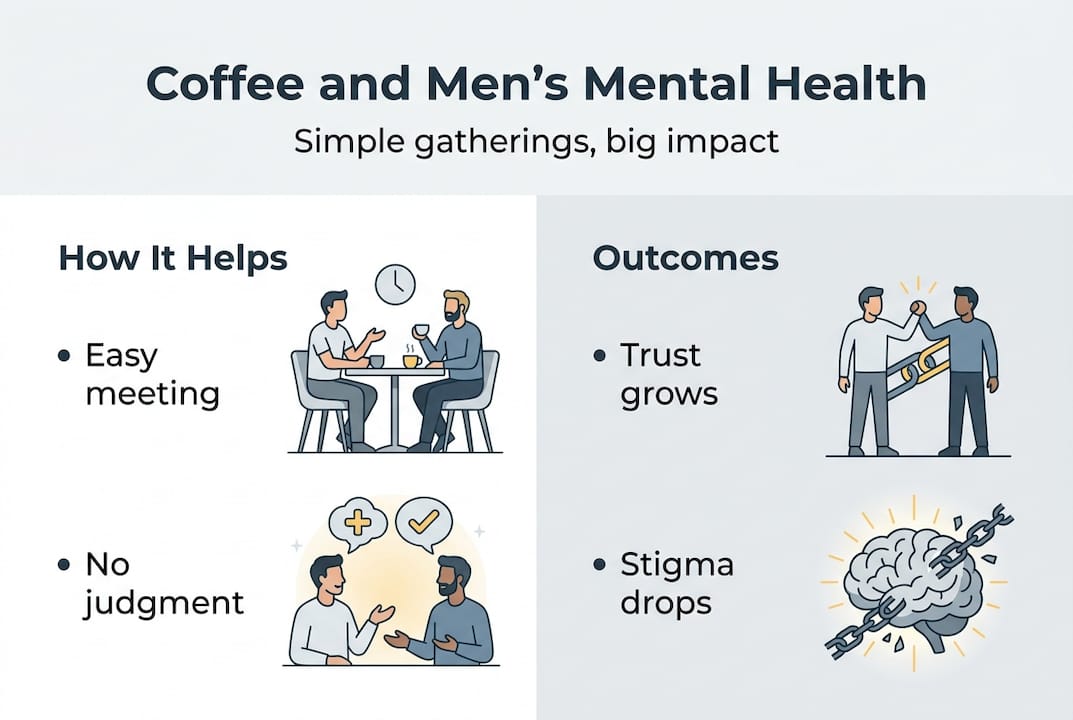
The contrast is stark. Formal services are vital and irreplaceable for serious mental health conditions, but they are not always the first port of call men will choose. Coffee events fill that gap brilliantly.
Several elements contribute to the lowered stigma at these gatherings. The absence of a "patient" label matters enormously. So does the presence of other men who are visibly comfortable being there. Seeing someone like you, someone who looks like he has it together, openly talking about a hard week is quietly revolutionary.
The role of the environment extends further than comfort. Research into barista support for wellbeing highlights how even the people serving the coffee can contribute to a psychologically safe atmosphere. Learning how to run coffee mental health campaigns effectively draws on all of these environmental cues.
The result is a space where vulnerability feels less like weakness and more like something ordinary men do on a Tuesday morning.
Inside a Cup For Bro event: What to expect
Understanding the model conceptually is helpful, but seeing it in action makes it real. If you have never attended a Cup For Bro event, here is what a typical meet-up looks like from the moment you walk in.
- Arriving — You turn up at a local venue, usually a café or community space. There is no sign-in sheet and no formal registration process. Someone will greet you.
- Introductions — The group introduces themselves informally. First names only, no job titles, no pressure to explain why you came.
- Coffee selection — You choose your brew. This small, familiar ritual immediately puts people at ease and gives everyone something to do with their hands.
- Conversation begins — A loose prompt or theme might be offered, but there is no agenda. Talk flows naturally, guided by whoever feels comfortable speaking.
- Listening and connecting — You are not obliged to share anything personal. Simply being present and listening is a valid and valued contribution.
- Wrapping up — The session ends without fanfare. People exchange numbers if they want to. Some come back the following week. Many do.
The initiative supports men by designing these events to feel like something you would do anyway on a weekend, not something you have to psyche yourself up for. That is the genius of the community approach.
Pro Tip: If anxiety is stopping you from attending alone, bring a mate. You do not need to tell him it is a mental health event. Tell him you heard about a decent coffee morning and fancy checking it out together. Getting through the door is the hardest part.
There is no right way to participate. Presence is enough. For those interested in starting coffee campaigns in their own communities, the format is deliberately simple to replicate.
The growing impact: Cup For Bro and the UK movement
Now that you have seen what a Cup For Bro event feels like, it is important to set it in the context of the UK's evolving mental health landscape. This is not an isolated initiative. It is part of a genuine cultural shift.
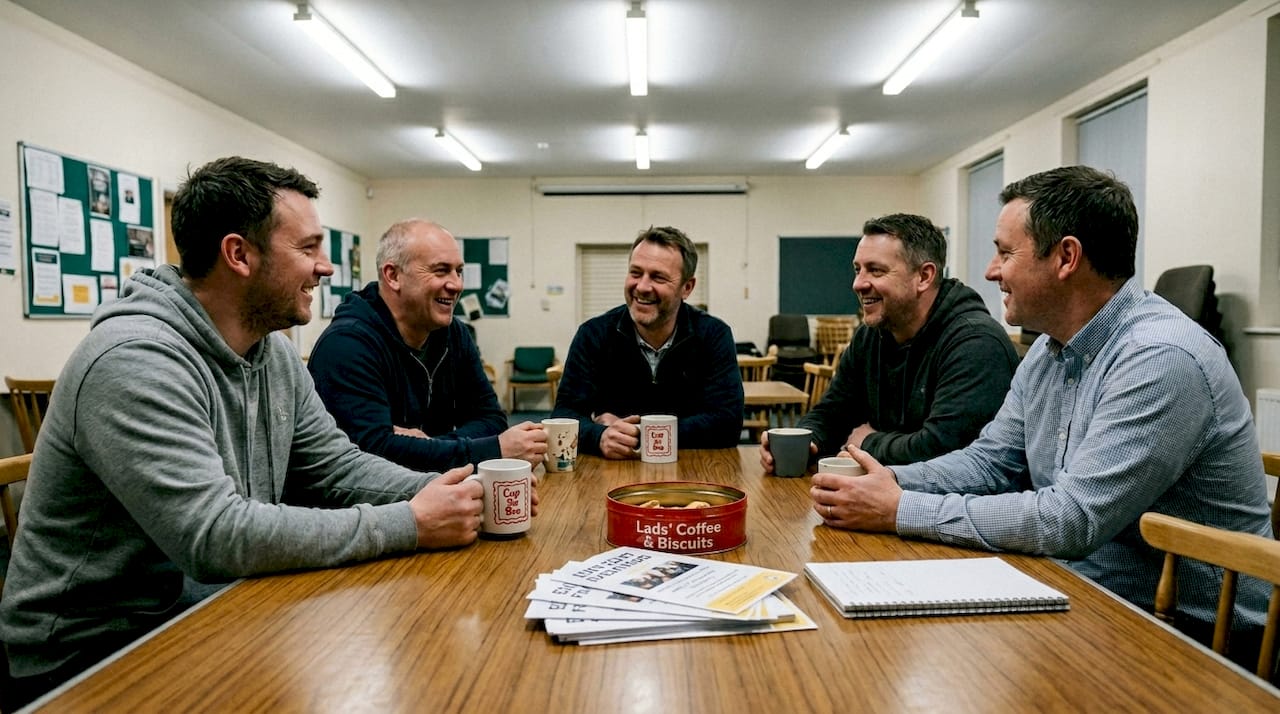
Cup For Bro aligns with UK trends in men's mental health via informal coffee-based peer discussions, prioritising community over clinical models. And it is not alone. Similar UK initiatives like Menfulness and Andy's Man Club use coffee catch-ups to create peer support networks with real reach.
| Organisation | Approach | Estimated reach | Unique feature |
|---|---|---|---|
| Cup For Bro | Coffee sales and events | National, growing | Funds mental health foundations directly |
| Andy's Man Club | Weekly peer groups | 100+ groups UK-wide | Structured but informal sessions |
| Menfulness | Coffee and mindfulness | Regional | Combines mindfulness with social connection |
| Brew & Chat | Community café events | Local and regional | Barista-led conversations |
The concrete impact of community-led models like these is becoming clearer:
- Increased awareness of men's mental health in communities that previously had no dedicated provision
- Local partnerships with cafés, barbershops, and sports clubs to bring conversations to spaces men already inhabit
- Charity fundraising through coffee sales that directly fund crisis support lines and counselling services
- Reduced isolation among men who previously had no peer network to speak of
Peer-led programmes differ from clinical interventions in one fundamental way: they meet men where they already are, both physically and emotionally. Local café fundraising is one practical way this model sustains itself financially while remaining accessible. The way cafés support mental health in communities is becoming a recognised and respected contribution to public wellbeing.
The mindset shift happening across the UK is real. Men are beginning to understand that asking for help is not a sign of weakness. It is, increasingly, just what you do over a good coffee.
Why conversations over coffee can change the game
Here is something most articles on men's mental health will not tell you: the obsession with measuring, scaling, and formalising peer support initiatives can actually undermine them. The moment a coffee morning gets a clipboard and a feedback form, something essential disappears.
What makes the Cup For Bro approach genuinely powerful is precisely its resistance to over-engineering. Trust is not built through structured agendas. It is built through showing up every week, remembering someone's name, and asking a follow-up question about something they mentioned last time. That is it.
Think about a man who has spent years telling himself he is fine. He comes to one coffee morning because a colleague mentioned it. He says nothing the first week. The second week he laughs at someone's story. By the fourth week, he mentions, almost in passing, that he has not been sleeping well. That small admission, in that safe space, can be the beginning of something that genuinely changes his life. No clinical intervention triggered that. A cup of coffee and a group of consistent, non-judgemental men did.
The uncomfortable truth is that normalising social vulnerability, the willingness to say "I'm struggling" without it being a crisis, is more transformative than most formal programmes. Exploring starting coffee initiatives in your own area is one of the most practical things you can do to contribute to this shift.
Join the movement: Take your next step
If this article has resonated with you, the next step is simpler than you might think. You do not need to attend a big event or make a grand gesture. You can start by trying one of our carefully crafted blends and knowing that every bag you buy funds vital mental health support across the UK.
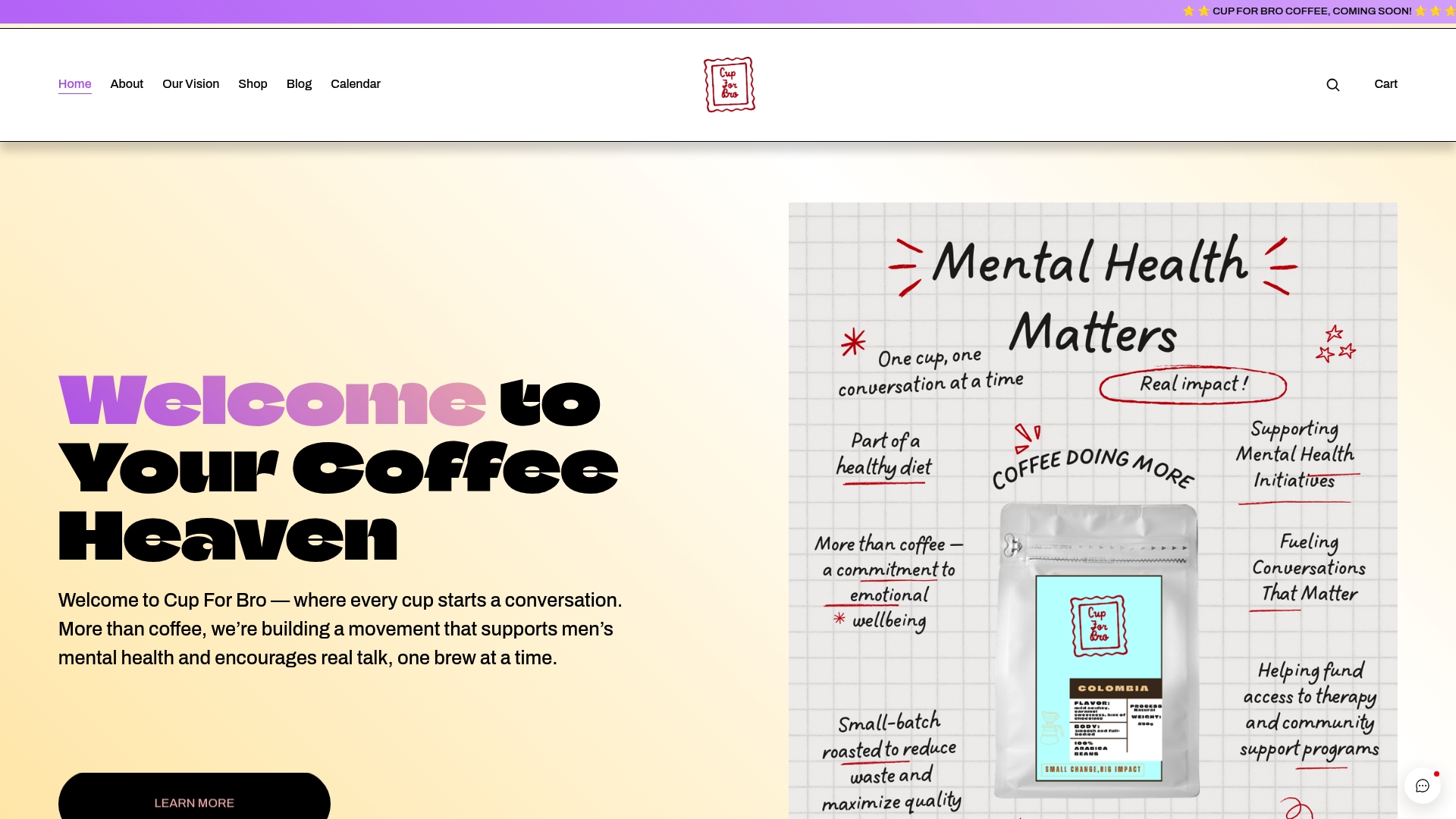
When you browse coffee blends, you are not just choosing a morning brew. You are contributing to a movement that is quietly changing how men in this country relate to their own wellbeing. Share the initiative with a friend, bring someone along to an event, or simply start a conversation over a cup. To understand the full Cup For Bro vision and how you can get involved, visit the website and take that first small step today.
Frequently asked questions
Is there a set 'model' or framework for Cup For Bro?
Cup For Bro does not follow a strict model but centres on coffee as a practical and accessible way to start supportive conversations among men, without clinical structure or formal methodology.
How can I join a Cup For Bro event?
You can join by checking for local meet-ups through the Cup For Bro website, where community events and coffee blends are listed for anyone wanting a relaxed, inclusive conversation.
Are there other similar initiatives in the UK?
Yes, groups like Menfulness and Andy's Man Club also use coffee catch-ups and informal peer gatherings to foster genuine support among men across the UK.
Do I need to talk about my mental health directly?
Absolutely not. The aim is to create a comfortable space where men can connect over coffee, with no pressure to share more than you are ready to.